Have you ever wondered what it would be like to step inside your own dreams? As someone deeply passionate about the intersection of neuroscience, artificial intelligence, and immersive technology, I'm excited to share how recent advances are making this once-fantastical idea a tangible reality.
The Science of Dream Decoding
Dreams have long fascinated both scientists and storytellers. But unlocking their mysteries requires more than imagination—it demands data. That's where groundbreaking resources like DreamBank and the DREAM EEG database come in.
DreamBank is the world's largest collection of research-grade dream reports, spanning ages 7 to 74 and providing a rich foundation for training AI models to detect recurring themes and emotions in dreams.
The DREAM EEG database pairs high-density EEG recordings with standardized dream reports. This unique combination allows researchers to directly link neural activity during sleep to the content and emotional tone of dreams.
These datasets are more than just numbers—they're the raw material for building systems that can understand, and even reconstruct, the landscapes of our subconscious minds.
From Brainwaves to Visuals: The AI Pipeline
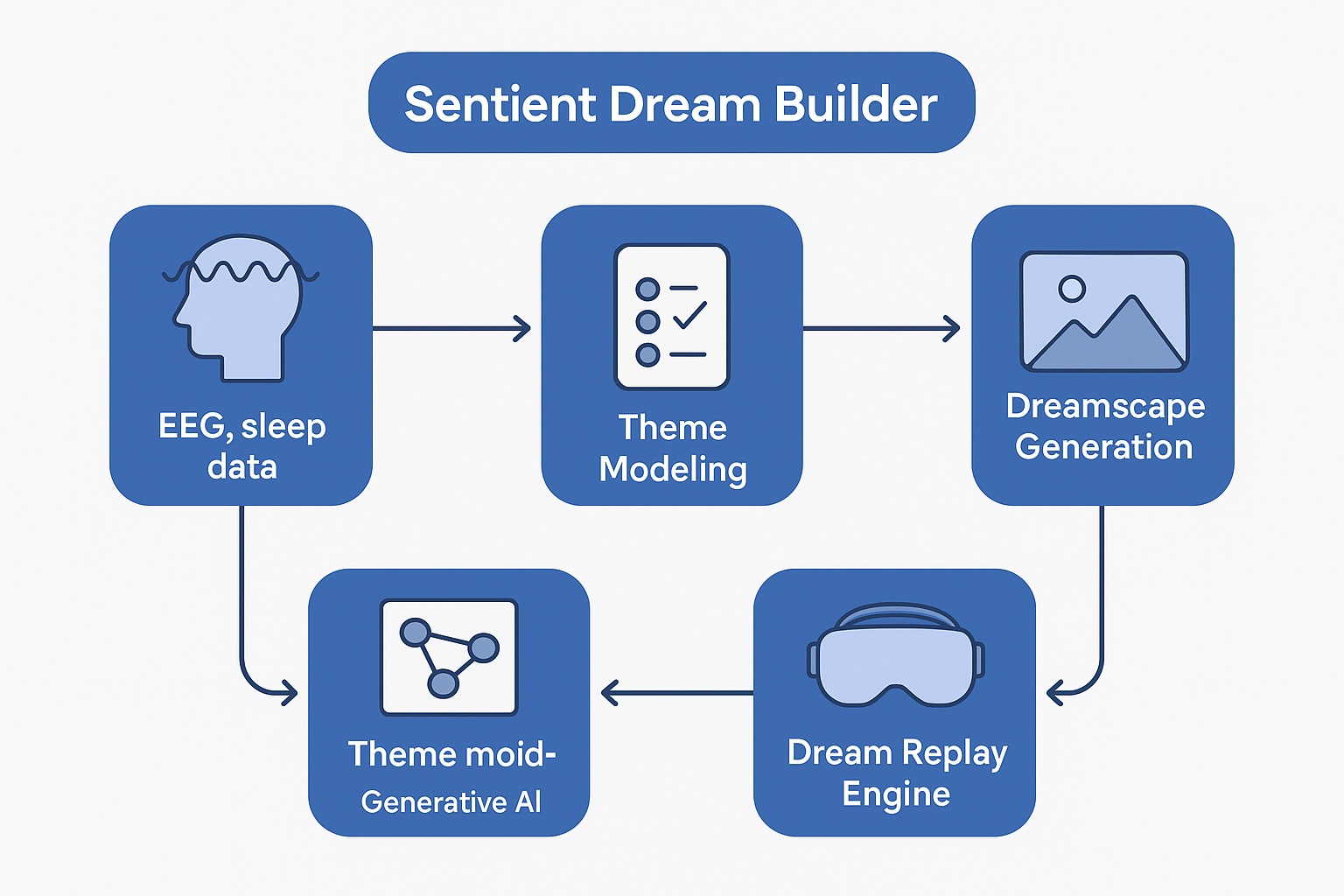
So, how do we transform fleeting dream fragments into something we can see, hear, and explore? Here's the process I've worked on, blending neuroscience with state-of-the-art AI:
Step 1: Capture & Decode
Using consumer EEG devices, we record brain activity during sleep. Upon waking, users provide a dream report—capturing the story while it's fresh. AI models then map EEG patterns to dream themes and emotions, creating a semantic representation of the dream.
Step 2: Visual Synthesis
By translating both EEG features and dream reports into a shared semantic space (using models like CLIP), we can condition powerful diffusion models (e.g., SDXL, ControlNet) to generate high-fidelity images and video frames. These visuals reflect both the neural data and the user's narrative, reconstructing dream scenes with remarkable realism.
Step 3: VR Dreamscapes
The generated images and videos are stitched into interactive 3D environments using XR platforms like Unity or Unreal Engine. We map dream elements—characters, places, actions—to 3D assets, and layer in immersive soundscapes and interactive features that mirror the dream's emotional tone.
Step 4: Personalized Exploration
Users can navigate, annotate, and revisit their dreams in VR, with ongoing feedback loops allowing the system to refine future reconstructions. The result? A deeply personal, evolving archive of your own subconscious adventures.
Why This Matters
This isn't just a technological marvel—it's a new frontier for self-discovery, creativity, and even therapy. By visualizing and interacting with our dreams, we can gain insights into our subconscious, process emotions, and spark new ideas.
The scientific foundation is robust:
- High-density EEG and dream reports enable precise mapping of neural activity to dream content.
- AI models trained on large, diverse datasets ensure accuracy and adaptability.
- VR/XR platforms close the loop, turning abstract data into lived, explorable experiences.
Looking Ahead
As we continue to refine these pipelines—optimizing for speed, privacy, and personalization—I believe we're on the cusp of a revolution in how we understand ourselves. Imagine a future where you can revisit your most vivid dreams, share them with friends, or even use them as inspiration for art and storytelling.
I'm actively working on this project right now! My current focus is on improving the neural decoding algorithms and creating more intuitive VR interfaces for dream exploration. The prototype system is already showing promising results in early tests, with participants reporting strong emotional connections to their visualized dream environments.
Research Materials
I've compiled detailed research notes, early prototype designs, and technical specifications for this project. Download the complete research package to explore the technical aspects of neural signal processing, dream visualization algorithms, and VR implementation details.
If you're as excited by this intersection of mind and machine as I am, let's connect! Whether you're a fellow researcher, a developer, or simply a dreamer, I'd love to hear your thoughts and potentially collaborate on this exciting frontier.